> For the complete documentation index, see [llms.txt](https://docs.yada.ai/llms.txt). Markdown versions of documentation pages are available by appending `.md` to page URLs; this page is available as [Markdown](https://docs.yada.ai/messaging-channels/whatsapp-twilio.md).
# WhatsApp (Twilio)
### Overview
Millions of businesses use WhatsApp to communicate with their customers, and Yada's WhatsApp integration allows you to easily manage those conversations as a team. Instead of juggling multiple mobile devices to handle WhatsApp conversations, you can efficiently receive and reply to WhatsApp messages from your Yada inbox, and respond faster to every guest.
### Instructions
Your team can manage WhatsApp conversations right from a shared inbox, just like they would email, SMS, or chat. Like other shared channels, WhatsApp channels will need to be set up by a Yada admin.
**Yada's WhatsApp channel is exclusively powered by Twilio, so you will need to use a** [WhatsApp-enabled number from Twilio](https://www.twilio.com/whatsapp). Twilio manages the approval process to enable WhatsApp Business. You will need to secure approval before setting up a WhatsApp inbox in Yada. The approval process follows [WhatsApp's Commerce Policy](https://www.whatsapp.com/legal/commerce-policy/), so be sure to abide by these guidelines to avoid any unnecessary delay.
## Part 1 - Twilio Approval
**Step 1**
Sign up or log into your existing Twilio account. In your Twilio dashboard, click the *Develop* tab in the left sidebar. Open the *Phone Numbers* section, click *Manage*, then select *Buy a number*.
If you've already purchased a Twilio number, you can also use this existing number. You can also port a number into Twilio by following Twilio's [usual process](https://support.twilio.com/hc/en-us/categories/203267567-Porting).
**Step 2**
If you are purchasing a new number, select all of the options you need under *Capabilities* and complete the check out process to select your number.
You can skip this step if you already have a Twilio number.
**Step 3**
Click the *Develop* tab in the left sidebar. Open the *Messaging* section, click *Senders*, then select *WhatsApp senders*.
**Step 4**
Fill out the [form](https://www.twilio.com/whatsapp/request-access) that appears.
**Step 5**
Click *Submit Request* to start the WhatsApp approval process. It may take several business days for Twilio to complete your approval.
You can monitor number approvals in the *Status* section of your *WhatsApp Enabled Senders* dashboard.
**Step 6**
Once your number is approved, proceed to Part 2 to set up your Twilio WhatsApp inbox in Yada.
## Part 2 - Connecting Yada to Twilio
**Step 1**
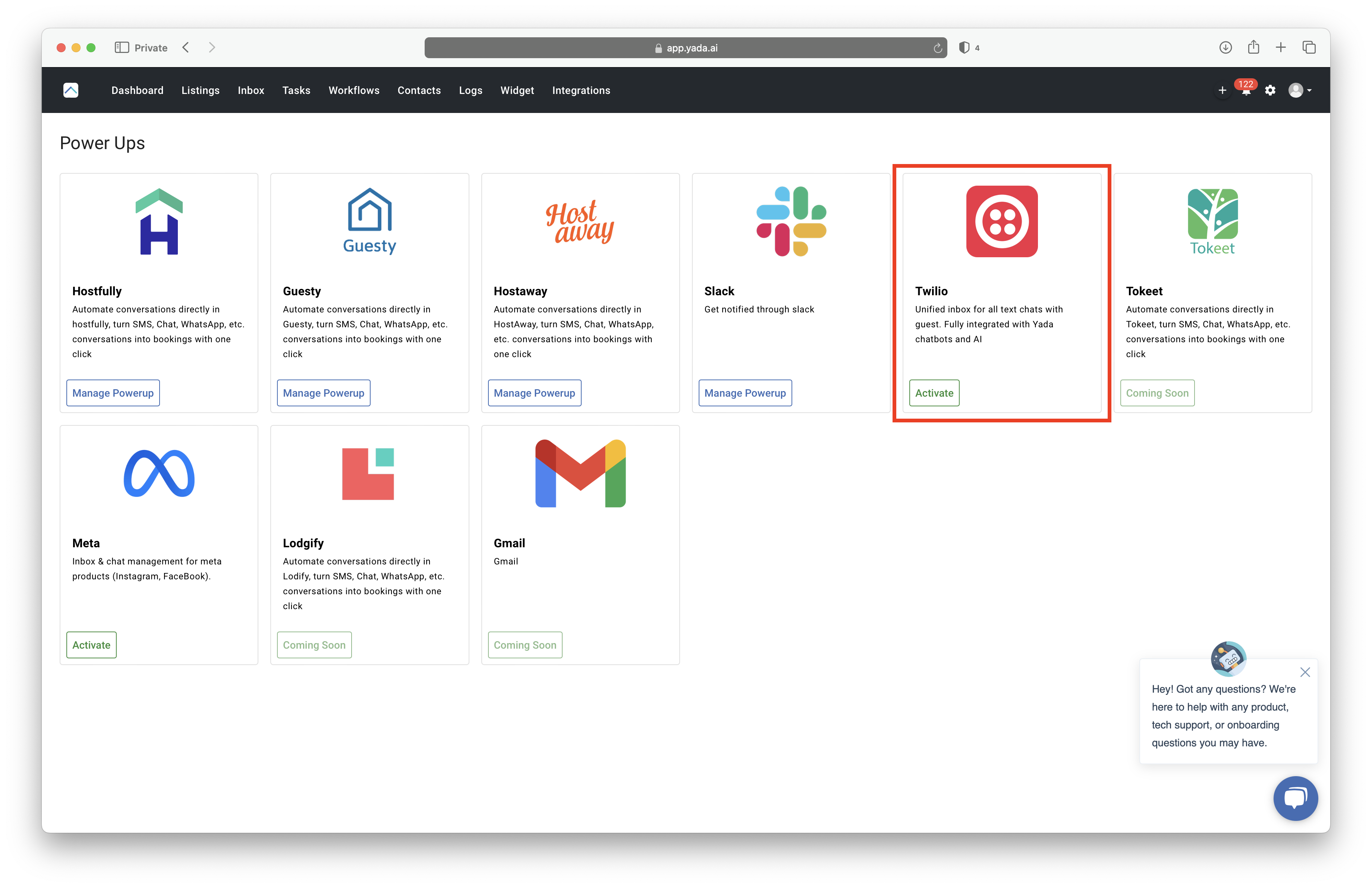
**You must be logged in as an admin**. Go to the "Integrations" page in yada and select "Twilio"
**Step 2**
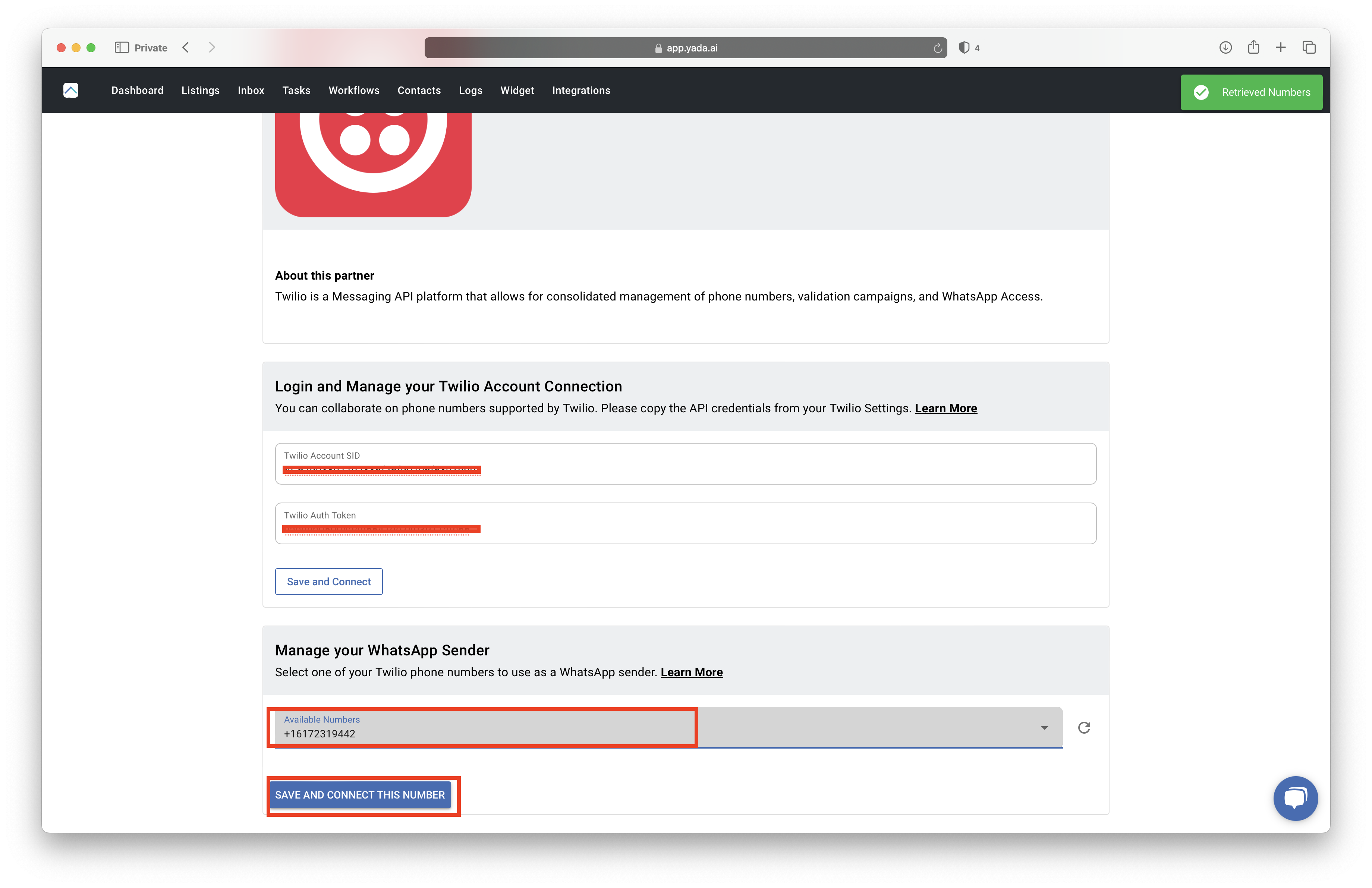
Copy the twilio Account SID and Auth Token
The *Account SID* and *Auth token* are found in your Twilio Console Dashboard, by clicking on your company name at the top left corner of Twilio.
**Step 3**
Once you've entered your Twilio account credentials, a new card will appear below the SID and Auth Token card. Click the "Refresh" button to get the most up-to-date list of available phone numbers
**Step 4**
Select your WhatsApp enabled number from this list
At this point, the number has been associated with the whatsapp sender, and the number webhooks have been set up. There is **one more webhook step** which we will need to take.
## Finalizing Webhook
Yada has successfully at this point created the incoming and outgoing messaging webhooks for the *phone number* but we still need to make sure these webhooks are also associated with the **whatsapp sender**
Not to worry, there's only one more copy / paste to go!
**Step 1**
In your Twilio dashboard, click the *Develop* tab in the left sidebar. Open the *Phone numbers* section, click *Manage*, then select *Active numbers*.
**Step 2**
In the settings for your WhatsApp number, scroll down to the *Messaging* section. Copy the full URL from the *'A Message comes in' Webhook* section-- you will use this later in the setup process.
**Note:** If your Twilio number does not show a Messaging section, or the webhook URL is not set, please [reach out to our support team](mailto:team@yada.ai), who will be happy to provide you with the webhook URL for your number.
**Step 3**
In the *Develop* tab in the left sidebar, open the *Messaging* section, click *Senders*, then select *WhatsApp senders*. Select your WhatsApp number to open its settings.
**Step 4**
Under *How would you like to configure this sender?*, select *Use webhooks.* Paste the webhook URL that you copied in Step 2 into the *'Webhook URL for incoming messages'* field.
**Step 5**
Click *Update WhatsApp Sender.*
**Step 6**
Refresh your page to ensure the webhook URL is present. If it is not displayed, repeat Steps 4 and 5 until you've ensured that the webhook URL appears after saving/refreshing the page.
**Step 7**
Now, test the connection by sending a message to your shared inbox from another WhatsApp number (such as your personal phone). Your message should show up immediately in Yada